The oil price shock of 2026 has become a test of business models as much as a trade in crude futures. An airline, a delivery company and an oil producer can react very differently to the same energy headline. What matters is where the cost lands, how quickly prices can change and whether customers keep buying after those prices change.
The central problem is a timing mismatch. Energy costs can reprice immediately; customer contracts, ticket sales and operating capacity often cannot. A company can report growing revenue while losing cash because its selling price reflects yesterday’s fuel bill. The most useful analysis therefore follows the margin through the business, rather than stopping at a bullish or bearish oil forecast.
Research cutoff: September 30, 2026. Market observations below are dated; scenarios are illustrative, not company forecasts.
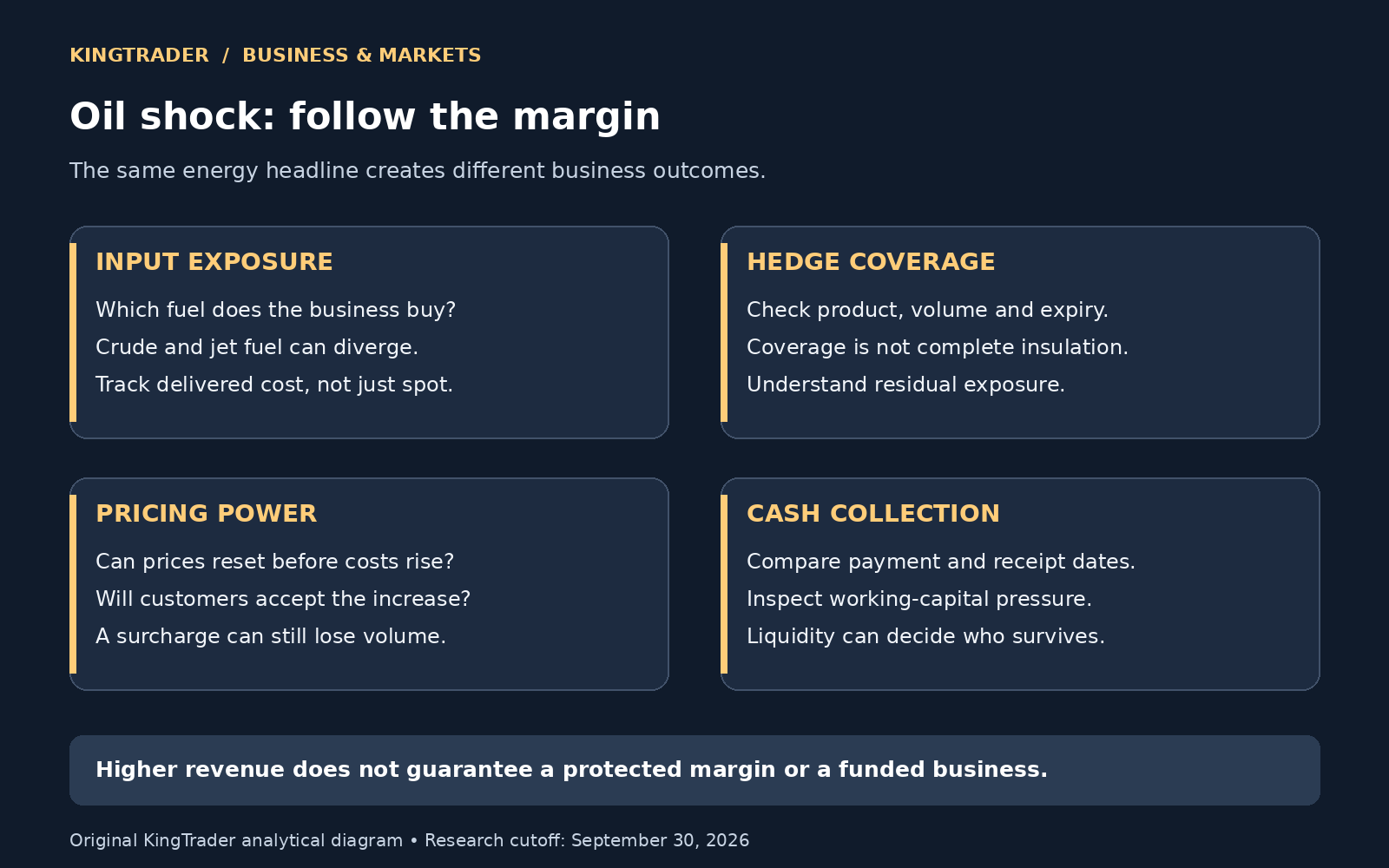
Why an oil shock creates unequal winners and losers
A supply disruption raises the price of a scarce input. But crude oil is only the first stage. Refineries turn it into diesel, gasoline and jet fuel; transport and regional inventories then influence the delivered price. The product a company actually buys may rise faster than the benchmark quoted on a trading screen.
That distinction separates a useful earnings thesis from a superficial one. A crude producer may receive a higher realised price, yet still face production interruptions, higher operating expenses or constraints on moving its output. A refiner depends partly on the spread between product prices and feedstock costs. An airline depends on jet fuel, seat demand and ticket yields. These are related exposures, not interchangeable trades.
The demand response adds a second layer. Higher transport costs can make a holiday unaffordable, reduce a retailer’s delivery volumes or squeeze a manufacturer’s customers. A firm with contractual permission to pass through fuel costs may still lose orders. Pricing power is the ability to preserve profitable demand after a price increase, not merely the ability to print a surcharge on an invoice.
Lufthansa: a large hedge does not eliminate the problem
On September 29, Reuters reported that Lufthansa’s chief executive expected its additional 2026 jet-fuel bill to exceed the €1.5 billion previously indicated in August. The airline maintained its €1.7 billion–€2.2 billion operating-profit forecast. The report put its 2026 fuel hedge coverage at approximately 86%.
Those figures illustrate why “mostly hedged” is not the same as “insulated.” A hedge can protect a benchmark price for a specified volume and period. It cannot automatically protect the difference between crude and jet fuel, every regional delivery premium or a changed flight schedule. Nor does it necessarily protect an airline from weaker passenger demand.
The earnings question is consequently broader than the remaining unhedged percentage. Can passenger yields offset the residual cost? Does capacity discipline preserve load factors? Are expensive routes still profitable after airport charges, staffing and fuel are included? Maintaining guidance is management’s assessment, not proof that every input risk has disappeared.
For an equity analyst, the next results should be read as a bridge: expected fuel expense, actual expense, fare recovery, passenger volume and other cost changes. A company that preserves profit by reducing loss-making capacity has a different story from one that preserves profit through durable pricing strength. The headline outcome may look similar while the future growth outlook differs.
Ryanair: absorbing costs can be a competitive decision
Ryanair offers a second mechanism. In a September 23 Reuters report, chief executive Michael O’Leary said the airline would not impose a fuel surcharge. The report also described a reduction in its fiscal 2027 passenger forecast from 216 million to 214 million as capacity was limited to reduce unhedged fuel exposure.
Refusing a surcharge can make commercial sense when a carrier’s cost position allows it to win price-sensitive customers. However, the strategy has to be evaluated against the whole fare and ancillary-revenue structure. A promise about one fee does not establish that the total customer bill or operating margin is unchanged.
Capacity discipline is particularly revealing. Selling more seats is not automatically attractive if the incremental flight has a poor contribution margin. A carrier can sacrifice some volume to protect cash and reduce exposure to costly inputs. This is a reminder that investors should examine profitable growth, not just passenger growth.
Comparing the two airlines requires matched periods and definitions. Lufthansa’s calendar-year discussion and Ryanair’s fiscal-year passenger outlook cannot be combined into a single hedge comparison without adjustment. Business mix, route geography and fare positioning also matter. The examples demonstrate different responses to a shared cost shock; they do not establish which stock is cheaper or which management team will outperform.
A logistics example: the margin disappears before revenue does
Consider a hypothetical delivery operator with monthly revenue of $1 million, fuel expense of $200,000 and all other operating expenses of $700,000. Its simplified operating profit is $100,000, or 10% of revenue. This excludes tax, financing and unusual items.
If fuel expense rises 30%, it increases by $60,000 to $260,000. With prices and volumes unchanged, operating profit falls to $40,000. A 30% move in one input has cut profit by 60%. The difference arises because the extra expense is large relative to the original profit pool.
Suppose contracts allow the operator to recover $40,000 through a surcharge. Profit then becomes $80,000, assuming all other inputs remain fixed. That still leaves a $20,000 shortfall. If customers reduce shipments, the company must also distinguish genuinely variable expenses from fixed fleet and depot costs. Lower revenue can hurt faster than costs can fall.
Cash timing can make this worse. Fuel may be paid weekly while the surcharge is collected from customers 60 days later. The income statement can show an eventual recovery while the business needs financing now. A profitable contract is not necessarily a self-funding contract during an input-price spike.
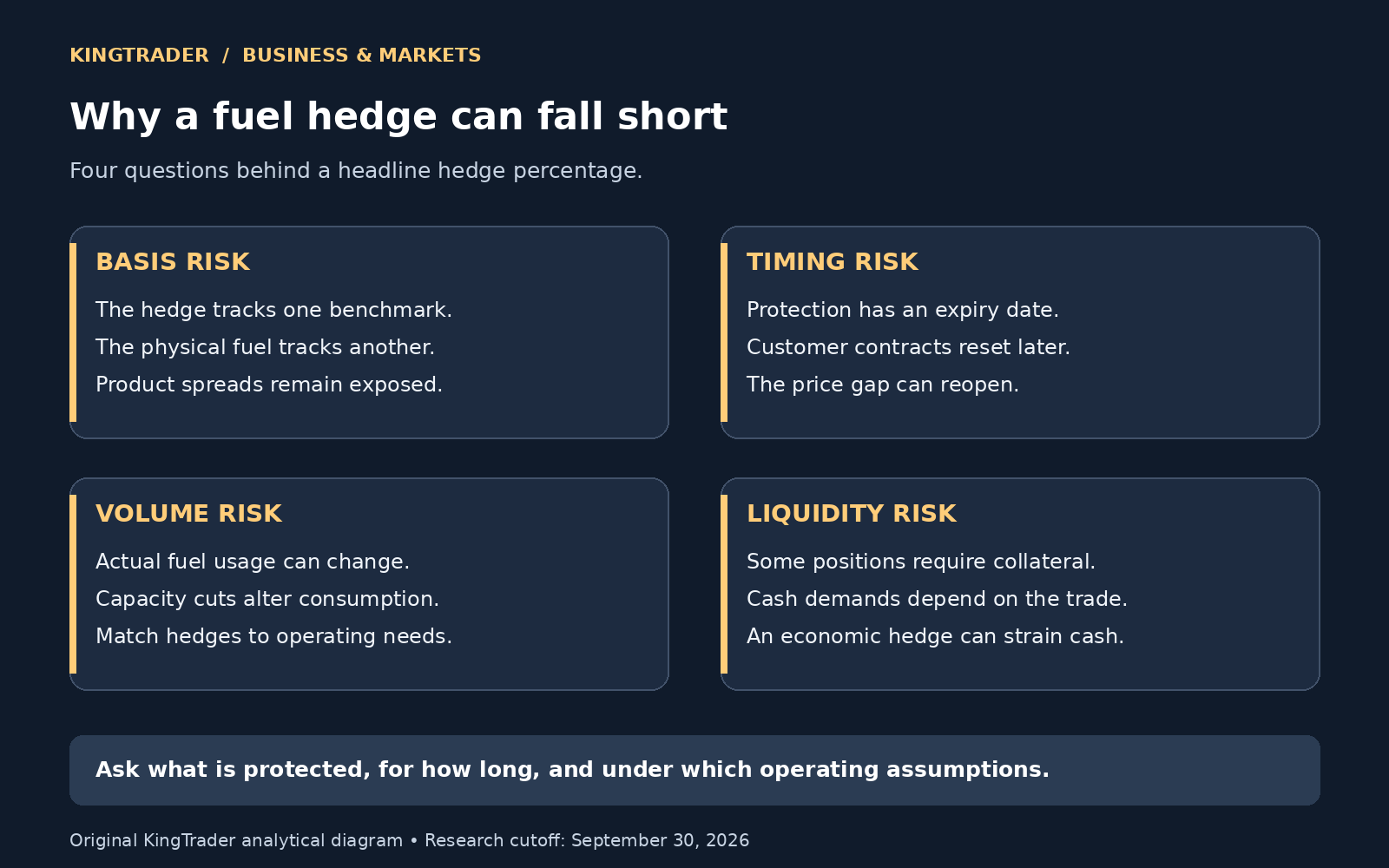
Three ways fuel hedging can disappoint
The first is basis risk: the hedge tracks one commodity while the physical purchase tracks another. A diesel buyer hedging crude still has exposure to refining spreads. The second is timing risk: protection expires before customer contracts can reset. The third is volume risk: actual consumption differs from the amount hedged.
There is also a liquidity dimension. Certain derivative positions require collateral as prices move. The economic hedge may ultimately work while creating an inconvenient cash requirement along the way. The direction of that requirement depends on the instrument and position; it should never be inferred simply from the existence of a hedge.
How to research the trade without chasing the headline
Start by identifying the exact exposure. For a crude futures trade, the contract month, settlement mechanism and term structure matter. For an airline stock, the exposure is an enterprise with labour costs, debt, competition and demand risk. For a transport business, it is the delivered input and the terms of customer contracts.
Then write two scenarios. In a persistent shock, costs stay elevated long enough for hedges to roll off. In a reversal, the energy price falls before businesses finish increasing selling prices. A company may benefit in the second scenario if it retains pricing and volume, but competitive pressure can quickly return the savings to customers.
Check the balance sheet alongside the margin. A low-cost operator with liquidity can withstand disruption and selectively win customers. A more leveraged competitor may have to cut capacity or raise capital at an unattractive moment. Debt maturity, working capital and committed credit facilities can be more consequential than a small difference in near-term fuel sensitivity.
Finally, compare the expected outcome with the valuation. A correctly anticipated earnings recovery can still produce a disappointing stock return if investors already paid for it. Commodity exposure, business quality and the price of the security are separate questions.
Questions business owners and traders should ask
Does higher oil automatically help every energy company?
No. Realised prices, production volumes, transport constraints, input costs and taxes all influence cash flow. Refiners and producers also have different economics. Analyse the actual business before treating a sector label as a directional signal.
What is the best evidence of pricing power?
Look for margin preservation alongside stable demand and cash collection after a price rise. A higher invoice alone is weak evidence. Customer retention, contract renewal terms and the speed of cost recovery give a more complete answer.
What changes the thesis?
A material shift in product spreads, hedge coverage, passenger or shipment demand, or liquidity can invalidate an oil-driven earnings thesis. Set those conditions before an event. The practical lesson of this shock is to follow the cost through the contract and into cash, then decide whether the market price fairly reflects the outcome.
Leave a Reply