Agentic AI pricing is turning an old software question into a new commercial argument: should a business pay for the people using a system, the work the system performs or the result it delivers? When an AI agent can handle a support request or complete a workflow, a traditional price per employee may no longer capture the value being sold.
The core problem is measurement. A vendor needs a billable unit that covers its costs and funds a profitable business. A customer needs a unit that corresponds to real improvement. Those requirements overlap, but they are not identical. A completed workflow may be useful; it may also require rework, create an unwanted handoff or solve a problem the customer did not have.
Research cutoff: September 30, 2026. Pricing is the public information checked at that date. Company results and hypothetical scenarios are identified separately.
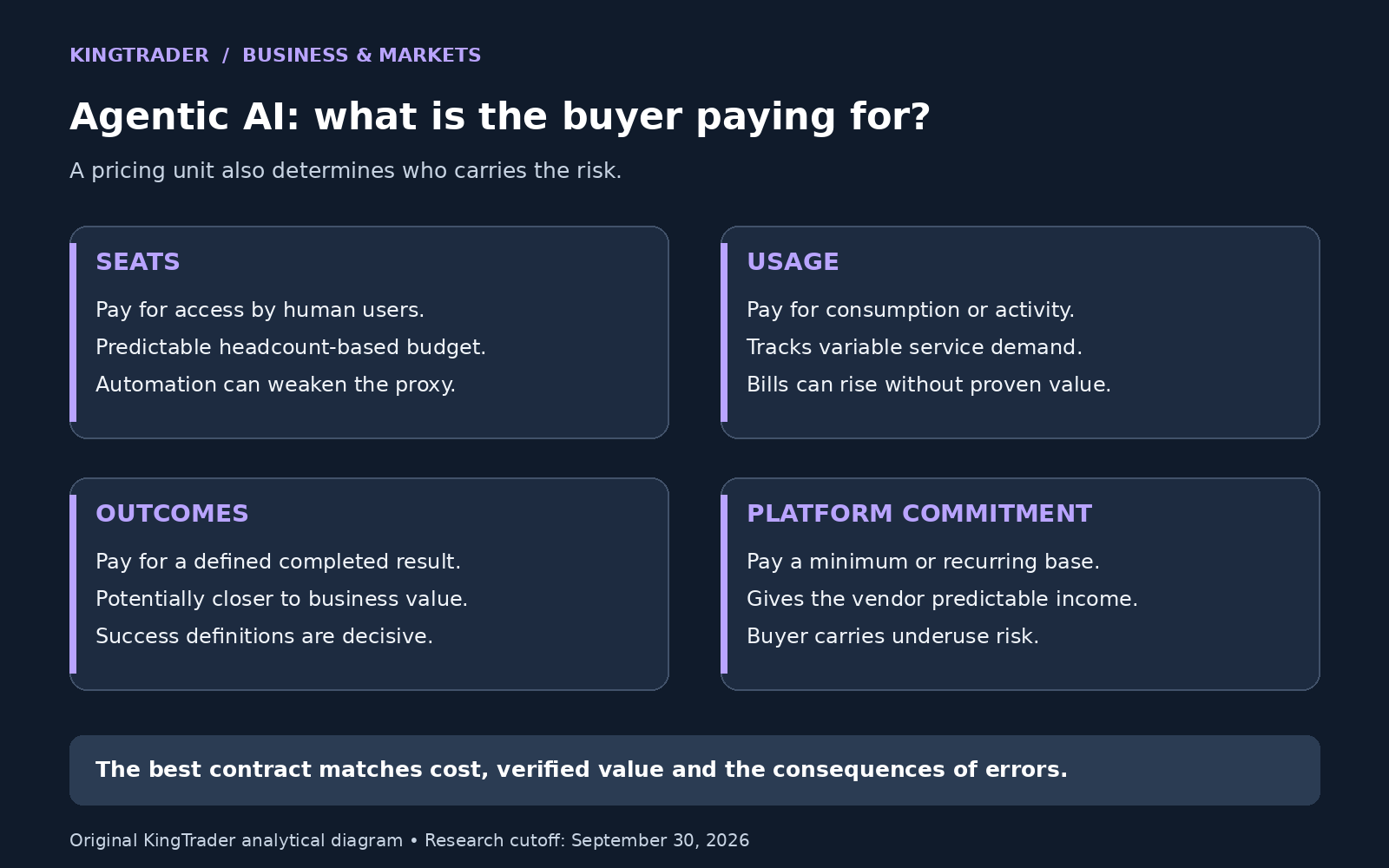
Why the software-seat model is under pressure
Seat pricing works well when users are a reasonable proxy for value. More employees using a customer-management system generally creates more activity and a larger subscription. The customer can budget around headcount, and the vendor gets a relatively predictable recurring revenue stream.
Automation complicates that relationship. If fewer employees can do the same work, charging only by seat can reduce the vendor’s revenue precisely when its software becomes more productive. Vendors may respond with premium subscriptions, usage charges, platform fees or payments linked to completed tasks.
Each option carries a trade-off. Usage pricing can cover variable computing costs but produce a surprising bill. Outcome pricing can align the invoice with customer value, but only if the result is well defined. A platform commitment gives the vendor predictability, while the buyer takes the risk that adoption falls short of the minimum spend.
There is no universally superior model. A complex compliance workflow may justify a different contract from a simple password-reset interaction. The best commercial design reflects the variability of the work, the cost of errors and the customer’s ability to verify success.
Salesforce: adoption metrics need careful interpretation
In second-quarter fiscal 2027 results, released August 26, 2026, Salesforce reported nearly $3.9 billion of combined Agentforce and Data 360 annual recurring revenue. Agentforce ARR exceeded $1.5 billion. The company stated that, effective that quarter, Agentforce ARR included its AI offerings, Slackbot and Headless 360. It also reported 3.2 billion Agentic Work Units during the quarter.
The definition change matters. A broadening product category cannot be treated automatically as growth of one unchanged product. ARR is a company operating metric, and work units measure activity; neither is the same as recognised revenue, incremental profit or independently verified customer savings.
For an analyst, the next step is to connect adoption to a financial bridge. How much new business is incremental rather than bundled into an existing contract? What happens to ordinary subscriptions when customers adopt automation? Does higher consumption improve gross profit after model and service costs? Are customers expanding voluntarily at renewal?
The strategic advantage of an established platform may lie in data, permissions and existing workflows. An agent can be more useful when it can take an authorised action inside the customer’s systems. But that access also increases the importance of governance. A persuasive demonstration of an agent taking action is not enough to establish safe, repeatable execution at scale.
Intercom: a concrete price, with a concrete definition problem
Intercom’s public pricing page, checked September 30, listed Fin from $0.99 per outcome. Its integrated helpdesk plans also carried seat charges. The page described outcomes as including a customer confirming resolution, not requesting more help after a response, or Fin completing a Procedure, including handoffs.
This is a commercially meaningful definition, but it is not equivalent to “every billed interaction fully solved without a human.” A handoff can be part of a completed procedure. Silence after a reply can count even when the customer has not explicitly endorsed the answer. Buyers need to understand those distinctions before calculating savings.
The point is not that such a pricing definition is inherently wrong. A useful handoff can save time, and a customer may genuinely be satisfied without replying. The point is that the purchased unit must match the buyer’s economic model. A forecast based on full human-ticket elimination will overstate savings if many billed outcomes still require staff attention.
Contract review should cover repeats, reopened cases, channels, integration work and any additional subscription or usage fees. The public headline price is one component of a procurement decision. It should not be presented as the entire cost of a production support operation.
A support-team scenario: attractive savings, then the rework test
Take a hypothetical company handling 10,000 support cases each month at an average all-in human cost of $6 per case. Its baseline monthly cost is $60,000. Assume an AI service handles 4,000 cases at $0.99 each, with no overlap or billing ambiguity in this simplified scenario.
The AI charge is $3,960. The remaining 6,000 human cases cost $36,000. Add $5,000 for platform costs, integration amortisation and monitoring. The total becomes $44,960, a potential monthly saving of $15,040. These are invented assumptions using a published headline unit price, not a claim about Intercom customer results.
Now stress-test quality. Suppose 20% of the AI-handled cases, or 800 cases, require extra human work costing $6 each. That adds $4,800, raising total cost to $49,760 and reducing savings to $10,240. If the rework cases are unusually difficult, their cost could be higher still.
The second caveat is cost flexibility. A $6 average case cost may include salaries and overhead that do not disappear immediately. Lower workload could create capacity rather than a reduction in payroll. That capacity can still be valuable if it supports growth or improves service, but it should not be booked mentally as immediate cash savings.
A credible business case therefore reports at least three outcomes separately: staff time released, actual spending reduced and customer experience preserved. Treating them as one number creates an attractive slide and a weak operating plan.
The vendor’s margin is a different calculation
Outcome pricing does not eliminate the supplier’s variable costs. A successful task may require several model calls, retrieval from knowledge sources, external tool use and retries. Difficult cases can consume far more computing and support resources than routine ones.
For a hypothetical vendor charging $1 per accepted task, variable costs of $0.20 leave $0.80 before fixed expenses. If a harder customer mix pushes those costs to $0.60, the contribution falls to $0.40 despite an unchanged headline price. Volume growth can therefore coincide with deteriorating unit economics.
This is why model efficiency, routing and workflow design have commercial significance. A cheaper model may handle simple cases well; a more expensive model may be necessary for complex decisions. The vendor must control costs without sacrificing the result that justifies the charge. A price war can pressure both sides of that balance.
For the infrastructure side of the same market, see KingTrader’s analysis of who turns AI spending into cash flow. Application revenue and infrastructure spending are connected, but the relevant profit tests differ.
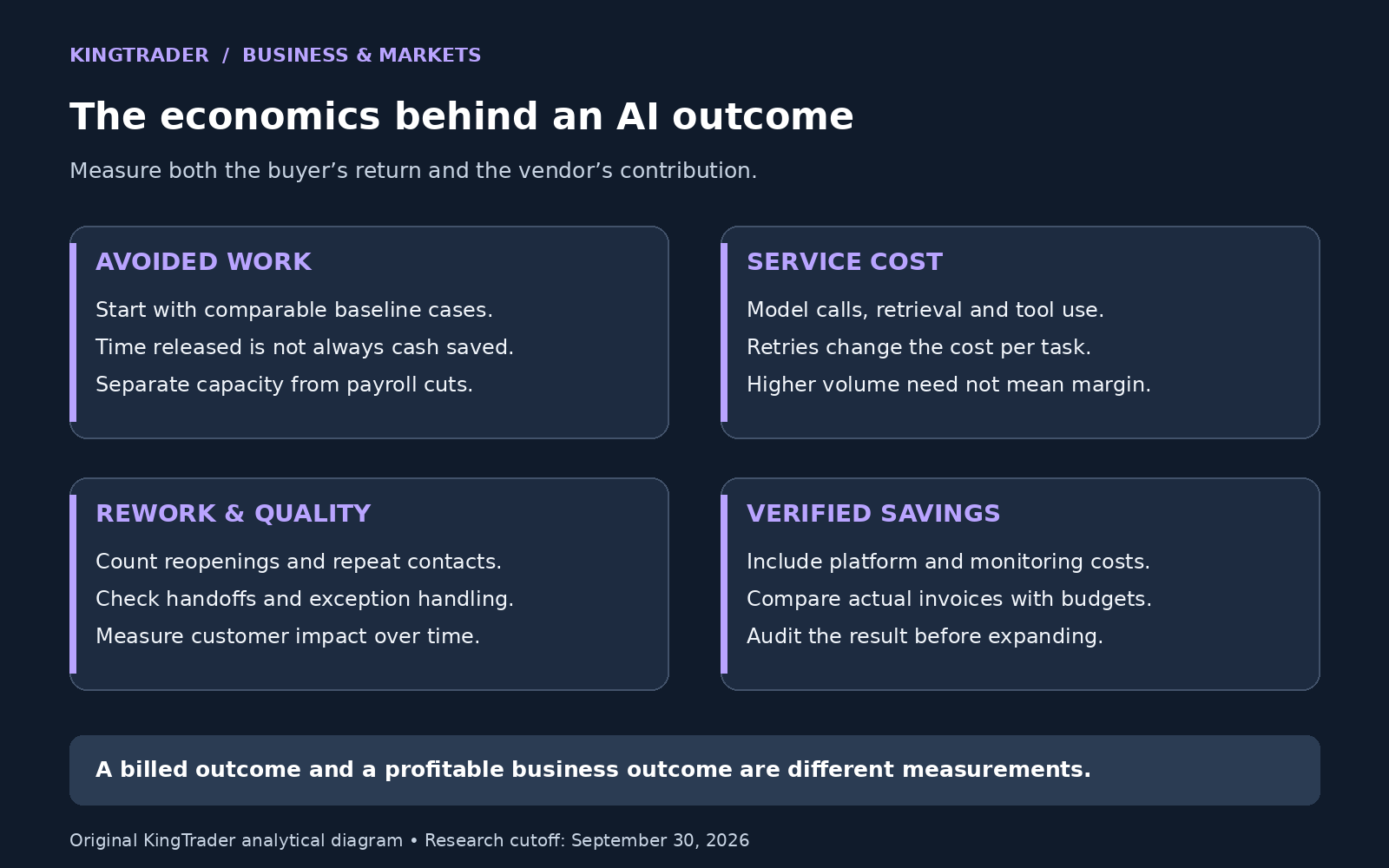
What a serious pilot should measure
Choose a narrow workflow with observable completion criteria. Define the baseline before deployment, including the mix of easy and difficult cases. Then measure the new system against comparable work. If the pilot receives only straightforward requests, its result will not represent the whole customer-service operation.
Track repeat contacts and reopenings over a suitable follow-up period. Monitor exceptions, inappropriate actions and escalation quality. A fast answer can look successful in the first minute and fail when the customer returns with the same unresolved issue.
Set permissions according to the consequence of an error. Retrieving an order status and authorising a refund are different actions. The workflow should specify which decisions need approval and how an action can be reviewed. Governance is part of deployment cost and product quality, not a decorative addition after launch.
Finally, compare actual invoices with the projected bill. This reveals whether the commercial definition behaves as expected at real usage levels. A successful pilot should survive both the operational audit and the financial audit.
Questions that matter for the AI business model
Does outcome pricing guarantee alignment?
No. It improves alignment only when the billed result reliably represents customer value. The definition, verification process and handling of rework determine whether the incentives are sound.
What should software investors watch?
Watch paid expansion, renewal behaviour, gross profit after service costs and the interaction between AI revenue and existing subscriptions. A growing usage statistic is useful evidence, but it cannot alone prove durable economics.
Where does the lasting advantage come from?
It can come from trusted workflows, proprietary customer context, efficient execution and distribution. A model demonstration is easy to admire; a reliable system customers renew is harder to build. The companies that solve both the measurement problem and the operating problem will have the strongest claim to recurring AI profits.
Leave a Reply