The stablecoin business model is moving beyond the question of whether digital dollars can travel quickly. The harder question is who gets paid when they do. An issuer earns money differently from a wallet, a payment processor or a merchant. Growing transaction activity can benefit one layer while leaving another with thin margins and expensive customer support.
Stablecoins are tokens designed to maintain a reference value, commonly one US dollar. That design does not make every issuer, blockchain or redemption route equally reliable. For business analysis, the core problem is connecting a transferable digital balance to a usable commercial service: funding it, moving it, converting it and resolving problems when something goes wrong.
Research cutoff: September 30, 2026. Company figures refer to the reporting periods stated. Illustrative calculations are not forecasts.
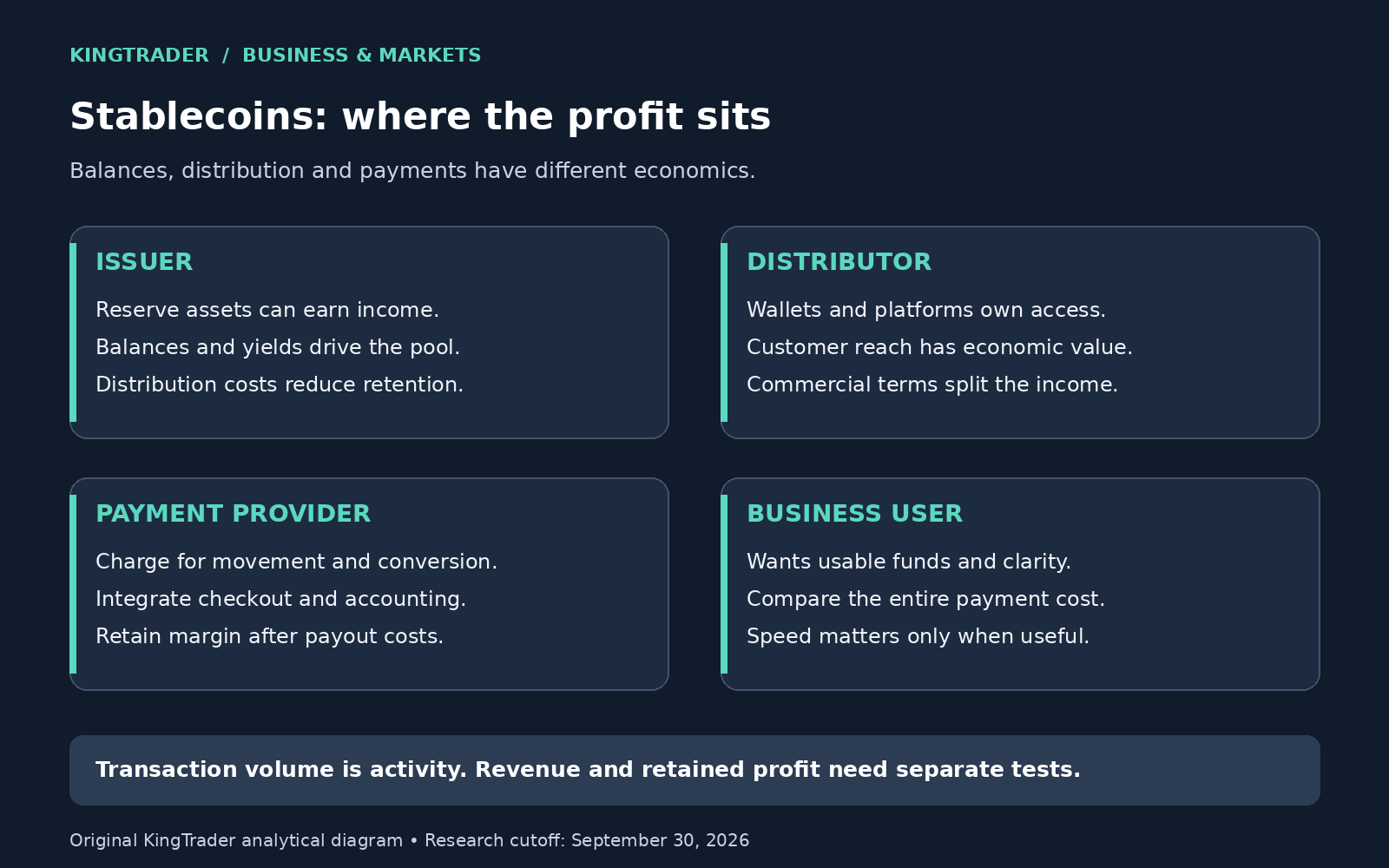
The core economic split: balances versus payments
A reserve-backed issuer can earn income from the assets backing outstanding tokens. Its economics depend on the average circulating balance, the yield on eligible reserve assets and the costs of distributing and operating the product. A payment provider, by contrast, may earn a fee each time money moves or is converted.
These engines respond differently to interest rates. More balances can increase an issuer’s reserve income, but a lower reserve yield can offset that growth. A payments business can grow through more customer transactions even when interest income falls. Conflating the two makes a stablecoin investment thesis dangerously incomplete.
A simple hypothetical shows the sensitivity. Average reserves of $10 billion earning 4% would produce $400 million in annual gross income before costs. If balances rise 20% to $12 billion while the yield falls to 3%, gross income becomes $360 million. Adoption improved, yet this simplified income line fell 10%. It is arithmetic, not a projection for any named issuer.
Distribution matters just as much. Exchanges, banks and wallets can own the customer relationship and negotiate part of the economics. A large token supply does not tell an investor how much income the issuer retains after distribution arrangements. The revenue bridge must include both balance growth and the price of reaching users.
Circle: activity is expanding faster than the top line
Circle’s second-quarter 2026 results, released August 5, reported $73.3 billion of USDC in circulation at quarter-end, up 19% year over year. Onchain transaction volume reached $14.8 trillion, up 151%, while total revenue and reserve income rose 7% to $701 million. Net income from continuing operations was $48 million; adjusted EBITDA was $143 million.
The different growth rates are the analytical point. Transaction volume measures movement, not the stock of income-producing balances, and neither is identical to retained profit. The same tokens can move repeatedly. Transfers can also involve financial-market activity rather than purchases of goods and services.
Consequently, $14.8 trillion must not be described as retail sales processed by Circle. Investors need to separate the reported onchain metric from payment revenue, end-customer use and economic value retained. Comparing adjusted EBITDA with net income also requires the company’s reconciliation; an adjusted measure is not a substitute for accounting profit or cash flow.
Circle illustrates a broader tension in digital finance. A network can become more useful while its monetisation remains sensitive to reserve yields and commercial terms. That is not a dismissal of adoption. It is a requirement to match the operating statistic to the revenue mechanism it actually supports.
Shopify and Stripe: the merchant wants usable money
In its June 2025 Shopify announcement, Stripe described bringing USDC acceptance to Shopify merchants across 34 countries. The design allowed merchants to receive their local currency in their bank account by default. This historical rollout is useful because it shows how stablecoin technology can sit inside an ordinary merchant workflow.
A merchant usually does not want to become a currency trader or manage blockchain infrastructure. The merchant wants an order marked paid, funds reconciled to the sale and a predictable amount available to pay suppliers. A processor that hides technical complexity can create genuine value, but that service still has a cost.
The relevant comparison is therefore the full delivered payment, not the blockchain fee alone. Funding charges, conversion spreads, processor fees, withdrawal costs, fraud handling and accounting work may all affect the outcome. A very cheap transfer can become an expensive commercial payment after these other stages are included.
This also changes the competitive analysis. The company with the fastest rail does not necessarily own the merchant. A platform embedded in checkout, reconciliation and customer service may have stronger distribution. New infrastructure can strengthen an existing intermediary when that intermediary makes it easy to use.
Visa: working capital remains necessary on a fast rail
Visa’s September 8, 2026 announcement described onchain credit using VisaNet settlement data to help finance stablecoin-linked card programs. It reported more than 160 such programs on its network and a stablecoin settlement volume above a $20 billion annualised run rate. An annualised run rate is a pace extrapolated from current activity, not completed annual revenue.
The importance is structural. Faster movement does not ensure a payment company has sufficient funds at the moment its settlement obligation is due. Customer receipts, card settlement and treasury funding can occur on different schedules. Credit still serves the gap, even when one part of the money flow runs on a blockchain.
Data can help a lender assess settlement receivables, but a smart contract cannot make poor collateral valuable or remove every borrower risk. Lending depends on enforceable claims, liquidity and underwriting. The business opportunity is to improve the machinery around those needs, rather than pretend the needs have vanished.
Visa’s example also shows why incumbent payment networks need not be displaced by every new rail. They can contribute transaction data, acceptance relationships and operational systems. The outcome will depend on commercial execution and fees, not simply whether the underlying technology is new.
A cross-border payment example with the costs exposed
Consider a hypothetical exporter receiving a $100,000 invoice. Its current provider charges an all-in $1,000, including conversion. A competing stablecoin route quotes a $20 network charge, a $300 service fee and a $450 conversion spread. The total is $770, creating a $230 saving before any additional reconciliation or compliance expense.
If the new workflow adds $250 of internal labour and support, the cost becomes $1,020. The apparent saving reverses. Alternatively, if the business can reuse the integration across many payments, the extra work per invoice may fall. Scale and workflow design determine whether the new route is economically attractive.
Time can be valuable too. Earlier access to funds might reduce borrowing or let the exporter pay a supplier promptly. But that benefit should be quantified separately from the fee saving. A transfer confirmation does not always mean local bank funds are available, especially where conversion or payout is still pending.
All numbers in this example are invented to reveal the decision process. They are not current quotes from Circle, Stripe, Shopify or Visa. A real comparison requires matched currency pairs, payment sizes, payout times and customer protections.
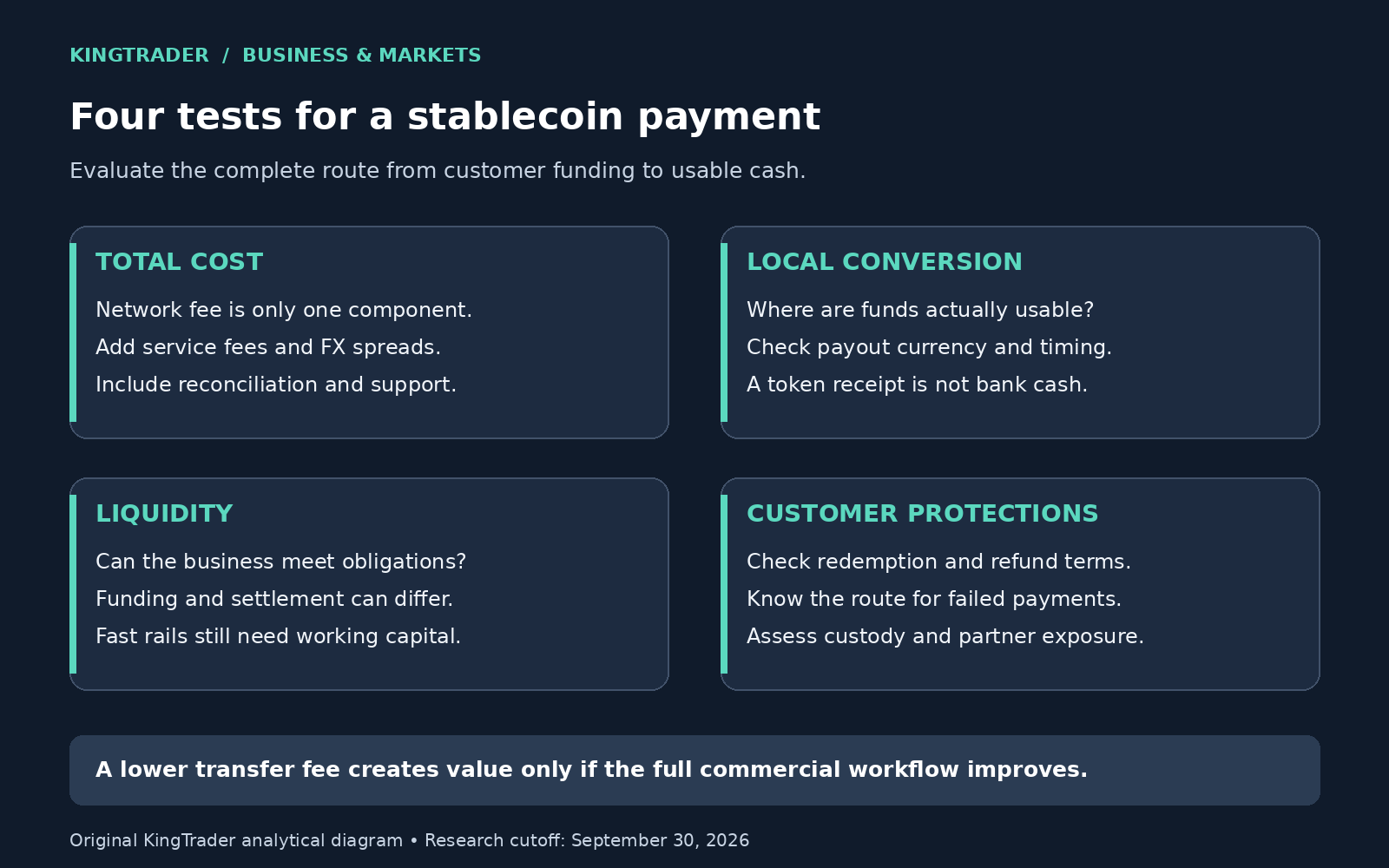
What makes a durable stablecoin business?
The first test is a recurring customer problem. Cross-border treasury movement, merchant settlement or access to dollar balances can be useful applications, but the evidence must show customers returning without unsustainable incentives. Promotional volume is less valuable than retained commercial usage.
The second is a defensible distribution channel. A payment API integrated into thousands of workflows may be harder to replace than a generic wallet offering the same token. Switching costs can come from reporting, reconciliation and trusted support, rather than from the token itself.
The third is margin after all obligations. Include revenue sharing, customer acquisition, custody, compliance and support where applicable. For an issuer, stress-test reserve income under different yields and balances. For a processor, examine revenue per transaction and the cost of payout. For a lender, include credit losses and the cost of funding.
The fourth is resilience. Redemption access, liquidity at weekends, concentration in banking partners and operational incident handling all deserve scrutiny. Public marketing about speed is not a substitute for clear terms about access to funds.
Questions investors should resolve
Is stablecoin transaction volume the same as payment revenue?
No. Volume records activity under a particular measurement methodology. Revenue depends on fees, reserve income and commercial agreements. Determine what the metric counts before using it to estimate sales or profit.
Will lower interest rates help or hurt?
The effect depends on the business. Lower reserve yields can pressure an issuer’s income, while lower funding costs may benefit some borrowers and payment providers. Balance growth and operating costs can offset or amplify the change.
Where is the strongest business-model evidence?
Look for repeat customers, measurable total-cost savings, transparent monetisation and profit that survives less favourable rate assumptions. The strongest stablecoin story is a useful service that earns a sustainable return after everyone in the chain has been paid.


Leave a Reply