Research cutoff: September 30, 2026. Company announcements and forecasts retain their original dates.

AI’s next constraint may sit outside the server room. Buying more processors does not solve a delayed grid connection, an unavailable transformer or a power contract that leaves a project exposed to volatile operating costs. The AI power bottleneck is therefore a business-model problem as much as an engineering problem: who can deliver usable electricity, when can they deliver it, and who carries the cost if demand disappoints?
For investors, the distinction matters. A chip supplier, a power producer, a regulated utility and a data-centre landlord can all benefit from the same expansion, yet their earnings depend on different contracts and different risks. Treating them as interchangeable AI stocks misses where value is actually created. This article examines the electricity constraint, a real nuclear contracting example and a worked project calculation, using information available on September 30, 2026.
Why electricity has become a market issue
The IEA’s April 2025 Energy and AI report estimated global data-centre electricity consumption at 415 terawatt-hours in 2024 and projected about 945 TWh in 2030 in its base case. That is a forecast for all data centres, rather than a measurement of AI alone. The report also identified grid bottlenecks as a possible source of project delays. These are useful planning assumptions, not a guaranteed demand trajectory. Read the IEA’s original analysis.
The current political debate shows why the opportunity is complicated. Reuters reported on September 29, 2026 that US lawmakers asked regulators to reject the proposed acquisition of AES, raising concerns about electricity rates and potential conflicts involving data-centre interests. AES said the transaction would not affect utility rates. The dispute is unresolved in the cited report. Its relevance is the competing claim on infrastructure returns, rather than evidence that any particular company has acted improperly.
The core problem: a megawatt must be deliverable
Electricity supply has several layers. Generation produces energy. Transmission moves it over long distances. Distribution and substations deliver it to the site. Protective equipment, cooling and backup systems allow the computing facility to operate reliably. A project can secure one layer and still be unable to run because another layer is incomplete.
A contractual promise also differs from physical delivery. A renewable power purchase agreement may settle financially against electricity generated elsewhere. It can support investment and manage price exposure without ensuring that a specific local grid can serve a new facility every hour. Annual clean-energy matching likewise does not prove hourly availability. The investor needs the connection agreement, delivery point, operating restrictions and start date, not just a headline capacity number.
This creates a scarcity premium for sites with credible power access. But that premium can disappear if a developer overpays for land, commits to equipment before permits are secured, or assumes full utilisation too early. A valuable connection is an input to a profitable project. It is not the profit itself.
Microsoft and Constellation: the contract is the business model
Constellation’s February 2025 results described a 20-year power purchase agreement with Microsoft supporting the launch of the Crane Clean Energy Center. The original announcement concerned restarting the previously retired Three Mile Island Unit 1. Unit 1 is distinct from Unit 2, the reactor involved in the 1979 accident. The agreement illustrates how a large buyer can underpin an expensive supply project; it does not by itself demonstrate completed delivery or a realised return.
The economic logic is straightforward. A generator considering a major restart needs confidence in future revenue. A buyer that expects long-lived computing demand may value predictable electricity costs and a credible supply source. A long contract can make financing easier by reducing uncertainty over future sales. Yet investors should avoid inventing a contract price or margin when those terms have not been disclosed. The public agreement establishes a commercial relationship, not a complete valuation model.
An equity analyst should separate the customer’s credit quality from construction risk. A strong customer can pay its bill while the project still experiences delays, higher costs or regulatory conditions. Similarly, a long contract can stabilise revenue while leaving the generator responsible for operating performance. Who bears outage replacement costs and inflation matters as much as the contract duration.
A worked example: the power bill versus the delay bill
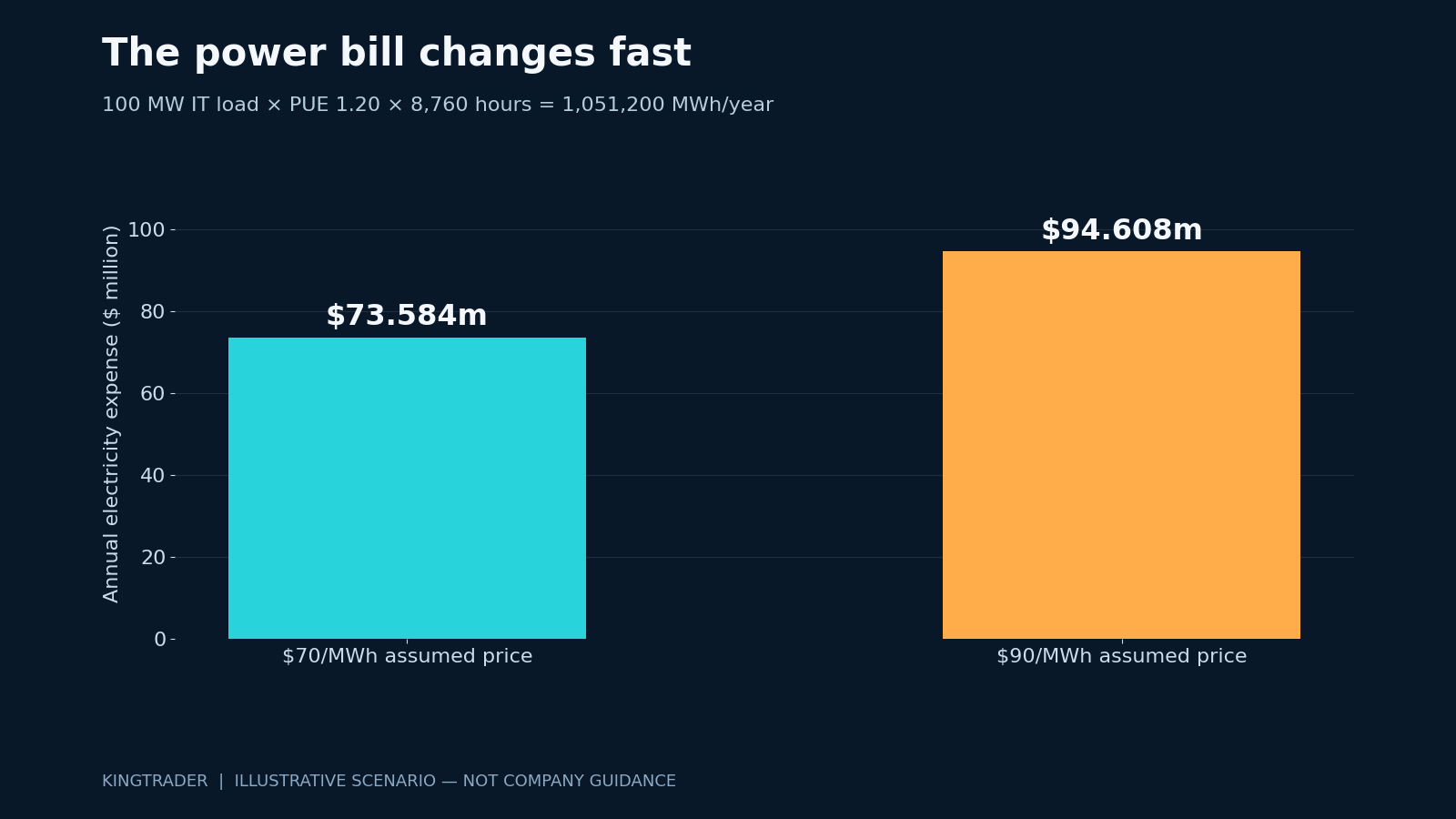
Consider a hypothetical facility with 100 MW of constant IT load and a power usage effectiveness, or PUE, of 1.20. PUE is total facility energy divided by IT equipment energy over the same period. Under these simplifying assumptions, the facility draws 120 MW. Annual electricity consumption is 120 multiplied by 8,760 hours: 1,051,200 MWh. Real loads vary, and an actual project would model that variation.
At an assumed all-in electricity price of $70 per MWh, annual power expense is $73.584 million. At $90, it becomes $94.608 million. The $20 increase adds $21.024 million a year. This scenario excludes taxes, demand charges and other costs unless already captured in the assumed all-in price; it is not a quoted tariff for any named operator.
Now suppose the same facility could generate $15 million of monthly contribution after variable operating expenses when fully running. A six-month connection delay would postpone $90 million of contribution before financing costs and other effects. That assumption is deliberately hypothetical. It shows why a buyer might accept a higher electricity price for an earlier, more reliable start. The correct comparison is the project’s whole cash-flow profile, rather than the cheapest energy quote in isolation.
The danger is overstating the value of speed. If customers have not signed firm commitments, running earlier may produce less revenue than expected. The developer might simply bring idle capacity online sooner. Power certainty and customer certainty have to be tested together.
Four different ways to earn from the bottleneck
A merchant generator can gain from higher market prices or negotiate long contracts. Its earnings depend on the balance between contracted and uncontracted output, fuel costs, outages and hedging. A company with already hedged sales may not receive an immediate windfall from a spot-price spike. Conversely, a fixed-price seller can suffer if its fuel or replacement-power costs rise.
A regulated utility generally earns through an approved revenue framework and investment base. Larger infrastructure spending may increase future earnings, but approval, financing and the allocation of costs are central. If the utility builds expensive assets for a customer that later withdraws, the question becomes who pays for stranded capacity. Customer deposits and minimum-payment commitments can materially change that exposure.
An equipment supplier earns from manufacturing and installation. Transformers, switchgear and cooling systems can face strong demand, but backlog is only useful when orders convert into profitable shipments. Fixed-price contracts, materials inflation, cancellations and factory expansion can dilute the apparent benefit. Cash advances and delivery milestones tell investors more than a large order number alone.
A data-centre developer earns by converting infrastructure into occupied capacity. It must fund construction, obtain power and win customers at prices that exceed the cost of capital. A lease with a strong tenant may protect revenue, but a development pipeline can consume cash for years before producing it. The route from announced megawatts to cash distribution is often long.
What would weaken the investment thesis?
Better chips and more efficient models can lower electricity per task. That does not automatically reduce total demand if usage expands faster than efficiency improves. The relevant variable is total workload multiplied by energy per workload. Investors should track both, instead of assuming either that efficiency kills the power thesis or that demand can only grow.
Other threats include slower customer adoption, oversupply in particular locations and financing costs that rise faster than project returns. A region with excellent power availability may lack network connectivity or the customer concentration required to attract tenants. A company can be exposed to an attractive market and still destroy value by building the wrong asset at the wrong price.
Questions to ask before trading the theme
Start with the actual operating milestone: has power been reserved, approved, connected or delivered? Then ask what revenue is committed, how much capital remains to be spent and whether the customer’s obligation survives a delay. Compare the company’s financing maturity with the construction timeline. Short-term funding against a long development schedule can create pressure even when the underlying demand is genuine.
For valuation, build a delayed-start case and a lower-utilisation case. A six-month delay should move cash flows into later periods and include continuing financing costs. A utilisation cut should reduce revenue while preserving realistic fixed costs. If the investment only works with immediate delivery and near-perfect occupancy, its margin of safety is narrow.
Does AI power demand make every utility a winner?
No. The benefit depends on location, contracts, allowed returns and who finances the required upgrades. The strongest operating position is access to usable power combined with creditworthy demand and a sensible construction cost. A utility headline cannot substitute for those details.
What should businesses do now?
Operators should compare sites on total delivered cost, connection timing and reliability. Stage equipment purchases around credible milestones, negotiate clear delay provisions and assess demand under conservative assumptions. Buyers of computing services should also ask how energy-price changes enter their contracts. The electricity constraint can migrate from the developer’s budget into the customer’s service bill.
The opportunity is real, but the decisive asset is the ability to turn reliable electricity into paid, productive computing. Follow the contracts and the cash. That is where a broad AI story becomes an investable business.
Sources and further reading
- IEA, Energy and AI, April 2025
- Constellation, 2024 results released February 2025
- Reuters, AES acquisition regulatory debate, September 29, 2026
- Related KingTrader analysis: AI spending and cash flow
KingTrader editorial analysis. Illustrative scenarios are not company guidance, price targets or personalised investment advice.
Leave a Reply