PIVOT POINT MOVING AVERAGE SYSTEM
The moving average is one of the most widely utilized indicators in technical analysis. The reason that this is the case is that the moving average is easily identifiable and easy to back test. Many automated trading systems use moving averages or some derivation of a moving average method to generate buy and sell signals. Moving averages are considered classic indicators and are very popular with traders today. Most technicians view the moving average as a way to signal a change in the direction of the trend, as well as a way to smooth out the volatility of the market.
THE SIMPLE MOVING AVERAGE
The simple moving average (the arithmetic mean) is the most popular moving average used in technical analysis. The simple moving average is the sum of the closing price over a period of sessions divided by the number of sessions. For example, a ten-day moving average would be the sum of the last ten days’ closing prices divided by 10. Each new day would drop the first day’s closing price and add the new day’s closing price. As new data is added to the calculation, old data is removed. By averaging the price data, a smoother line is produced and the trend is much easier to recognize. The disadvantages of the simple moving average is that it only takes into account the time period of the sessions covered in the calculation and it gives equal weight to each day’s price.
The moving average is the average of the CLOSING PRICE (sometimes referred to as the settlement price) of a defined number of sessions. The moving average is a lagging indicator. The purpose of the moving average is to indicate the beginning and ending of a trend. Since the moving average follows the market, the signals it generates occur after the trend has already changed.
It has been postulated that most traders lose their money in the markets. If reason stands that most traders focus on moving average values that are predetermined by default settings in their charting software packages or use the media’s favorite 200 day moving average, it’s no wonder people lose. They are following the same indicator.
BEAT THE STREET
As Yogi said to Boo Boo…”lf you want to do better than the average bear, then you have to think better than the average bear”!
If you want to beat the street, then you need to think and use a different set of values or understand how signals are generated. Also, I do not want to follow and base my trading strategies on what everyone else is looking at, so when it comes to moving averages, I want to look at different sets of conditions and time
periods. Think for a minute if lots of traders are watching for trade signals on ten, twenty and fifty periods, and if the statement holds true that the majority of traders lose, then why do I want to watch those moving averages? Some traders and technical analysts use various ways to calculate moving averages, such as the simple, weighted and exponential. I prefer the simple moving average and a different set of values for my moving average, namely the Pivot Point.
As you will recall, the Pivot Point calculation provides the mean (average) for the session’s trading range. (H+L+C/3).
The moving average section discusses how the moving average helps clarify the market’s price flow by extending price analysis over a certain period of time. In this manner, moving averages can demonstrate when a market enters an extreme condition by how far it departs from the mean. Price action will either
move toward the moving average or price will return to the moving average to retest that level.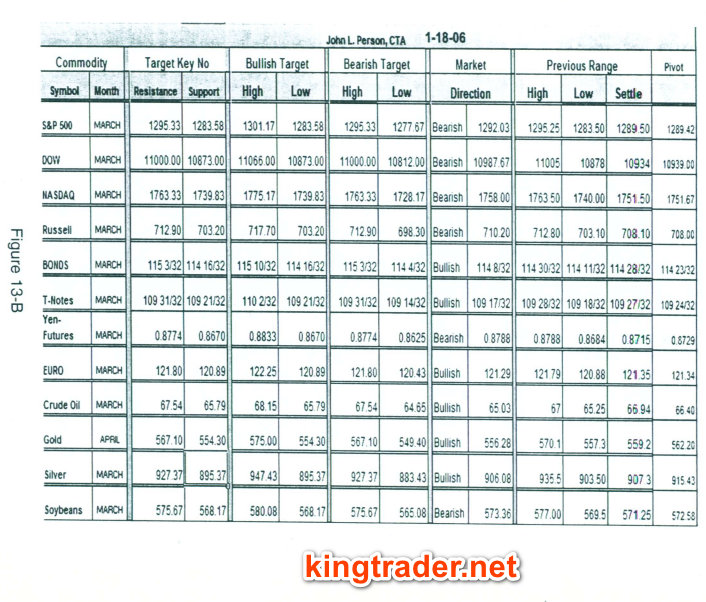
The “Market Direction Number” that was shown in the excel sheet in Figure 13-B is a combination of the use of price session information (Pivot Point number) over a period of time (moving average). The market direction number utilizes cumulative data from the High, Low and Close for a session. This information provides a clear picture of the “average true price” for that time period. The market direction number is then calculated by taking the average Pivot number from the past three periods. Any time frame can be utilized to calculate the number. However, the longer the timeframe, the more significance the number will hold. To calculate the market direction number, add three Pivot Points from the same session and divide by three. The purpose of using the Pivot Point in the moving average calculation is that the Pivot Point will show the continuance of the trend.
(Pivot + Pivot + Pivot)/3
As stated previously, the market direction number or the 3 period Pivot Point Moving Average can act as a support number in bullish conditions and has a high degree of importance when one of the Pivot Point calculations for the current session coincides with that number or is close to it. The market direction number holds true as a resistance number in a bear market condition. If other numbers coincide with the market direction number, such as the actual Pivot Point or an R-1 number, then it would serve as the target high number for that specific time period. Another way of using the 3 period Pivot Point moving average is to use it as a Point of reference or fair value; When the market price departs or deviates too far from the mean, then you can use the extreme support or resistance number such as R-2 or S-2 or the farthest target number of that direction as a potential turning Point.
When various time frames are incorporated into the analysis, (daily, weekly and monthly), there is more certainty that the target price level can generate the anticipated reaction. If the market gaps too far from the daily Pivot Point moving average, use the Monthly and or Weekly Target support and resistance numbers to help identify a targeted reversal support or resistance Point.
Figure 14 shows a spot FOREX British pound daily chart with the 3 period Point Moving Average overlaid on top of prices. Notice as the market changes conditions from bearish (downtrend) to bullish (uptrend), prices bounce off of the moving average as a support line and trade off the moving average as a ceiling of resistance.
If you notice the price action from November 15th to November 25th we were in a consolidation phase as prices moved above and below the moving average. The moving average went virtually in a flat line with a bias to an upside slope. This was hinting that prices were getting ready to change direction. When you watch the moving average in relationship to the underlying price action, sometimes we can get clues as to the true market price direction using the Pivot Point average. One reason is because it factors in the overall range and the relationship that the close has to that range. If the close is closer to the high, the average will be at a higher assigned value.
Using the 3 period Pivot Point will help you filter out much of the market noise and give you a truer sense of the market’s fair value within the price range of the past three trading periods.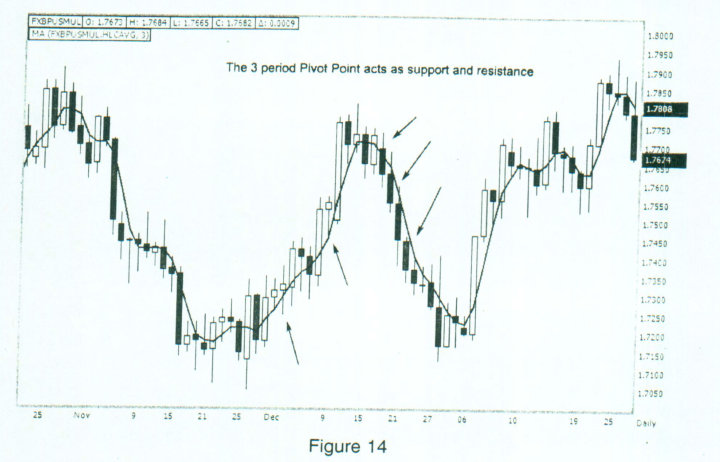
At times, the slope or angle of the Moving Averages can help give you a clue as to the market’s true strength or weakness, especially when combined with candlestick charting. The angle or slope helps filters out the noise and you can see if the market’s value is progressively appreciating or depreciating.
When a market goes from the trending phase into the consolidation phase, it is the slope or angle of the Pivot Point Moving average that can help you identify the next potential price direction from the consolidating phase, e.g. a continuation or a trend reversal move. For added clarity, when combined with identifying a high probability bottom or top forming candle, you have added confirmation of a potential move.
In figure 15, the graph shows a representation of a Pivot Point Moving average in a declining trend phase. Then as prices consolidate, the Pivot Point average measures the typical price rather than the close and we can therefore determine what the true market value is and which way prices tend to be moving. Markets sometimes demonstrate extreme volatility at turning Points and with the moving average approach; it can help filter out the noise inflicted by wide price swings. These swings often lead to confusion, or worse, traders get whipsawed or chewed up.
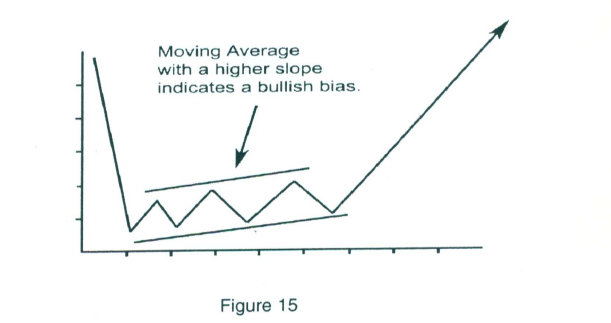
As the moving average slopes up. it indicates that the market values are also tending to trade higher. Eventually, we see a trend reversal, which is what the direction of the moving average indicated.
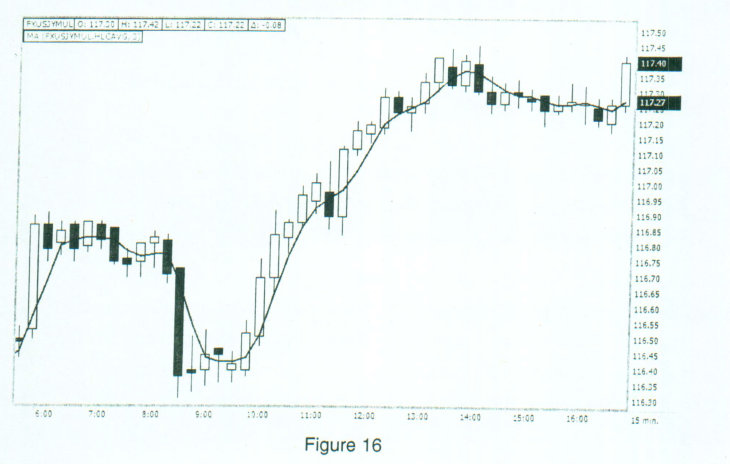
The three period Pivot Point moving average works as a tool to confirm triggers and exits by price action closing above or below the moving average Pivot line. We have a 15 minute chart on the spot FOREX Japanese Yen currency. As the market forms a bottom at 9:00 am, notice how the moving average forms a cup formation as the price of the market closes above the moving average.
This gives us a clue that the market is starting to change from a bearish trend condition, to a consolidation phase and is giving a clue that the market is starting to move into a reversal of the current trending condition.
As the market starts to establish higher highs and higher lows, it is also closing above prior highs and most importantly, closing above the three period Pivot Point moving average. Now the average starts to act as a support target until we reach the top; now the moving average starts to flatline again as prices go into another consolidation phase.
The following Japanese yen chart in Figure 16, provides a good example of a high close hammer trigger, confirmed by the price closing above the moving average Pivot line.



Leave a Reply