Research cutoff: September 30, 2026. Company announcements and forecasts retain their original dates.

A lower factory quote can produce a more expensive product. Tariffs, freight, quality failures, inventory and delivery uncertainty all sit between the purchase order and the final margin. That is why the tariffs and supply chains debate in 2026 needs to move beyond choosing the country with the lowest wage or the most favourable headline duty.
The core business problem is how to secure reliable supply without paying more for resilience than it is worth. Diversification can reduce dependence on one location, but it can also duplicate tooling, weaken purchasing power and introduce unfamiliar operating risks. A tariff truce can improve sentiment while leaving product-level implementation unresolved. The right response is a costed operating decision, based on information available on September 30, rather than a bet that one political headline settles the next decade.
The latest trade headlines need careful reading
Reuters reported on September 28 that the United States and China planned more favourable tariff treatment for $30 billion of goods each. The report said the announcements did not specify the extent of the reductions or implementation timing. That distinction matters to an importer: a policy intention should not be entered into the costing spreadsheet as an enacted duty reduction. The product list, classification and effective date remain decisive.
The WTO’s September 9, 2026 Goods Trade Barometer read 102.0, above its baseline of 100. Electronic components were particularly strong, while container shipping was slightly below trend. This is a leading indicator, not a forecast that every exporter will grow or that tariff risk has disappeared. The WTO release shows why aggregate resilience and company-level stress can coexist.
The core problem: optimise delivered economics
A supply-chain decision should begin with the price of a saleable unit at the destination. That includes the factory price, transport, insurance, applicable duties, brokerage and handling. It also includes expected defects, rework, returns and the cost of financing inventory. For businesses selling seasonal or rapidly changing products, late delivery can be more expensive than a modest increase in manufacturing cost.
These costs behave differently. A duty may scale with the customs value; freight can vary with volume and routing; tooling is often a fixed investment. Defect rates depend on process control and can improve during a ramp-up. A single percentage added to the purchase price cannot capture all of this. Model each component explicitly and document its assumptions.
Volume is another constraint. A supplier that performs well on a trial order may struggle with a tenfold increase. The buyer needs evidence of capacity, yield, skilled labour and component availability. Relocating final assembly does not necessarily relocate the upstream network. The business may remain dependent on the same critical inputs even after changing the address on its purchase order.
A worked comparison: the cheap quote loses
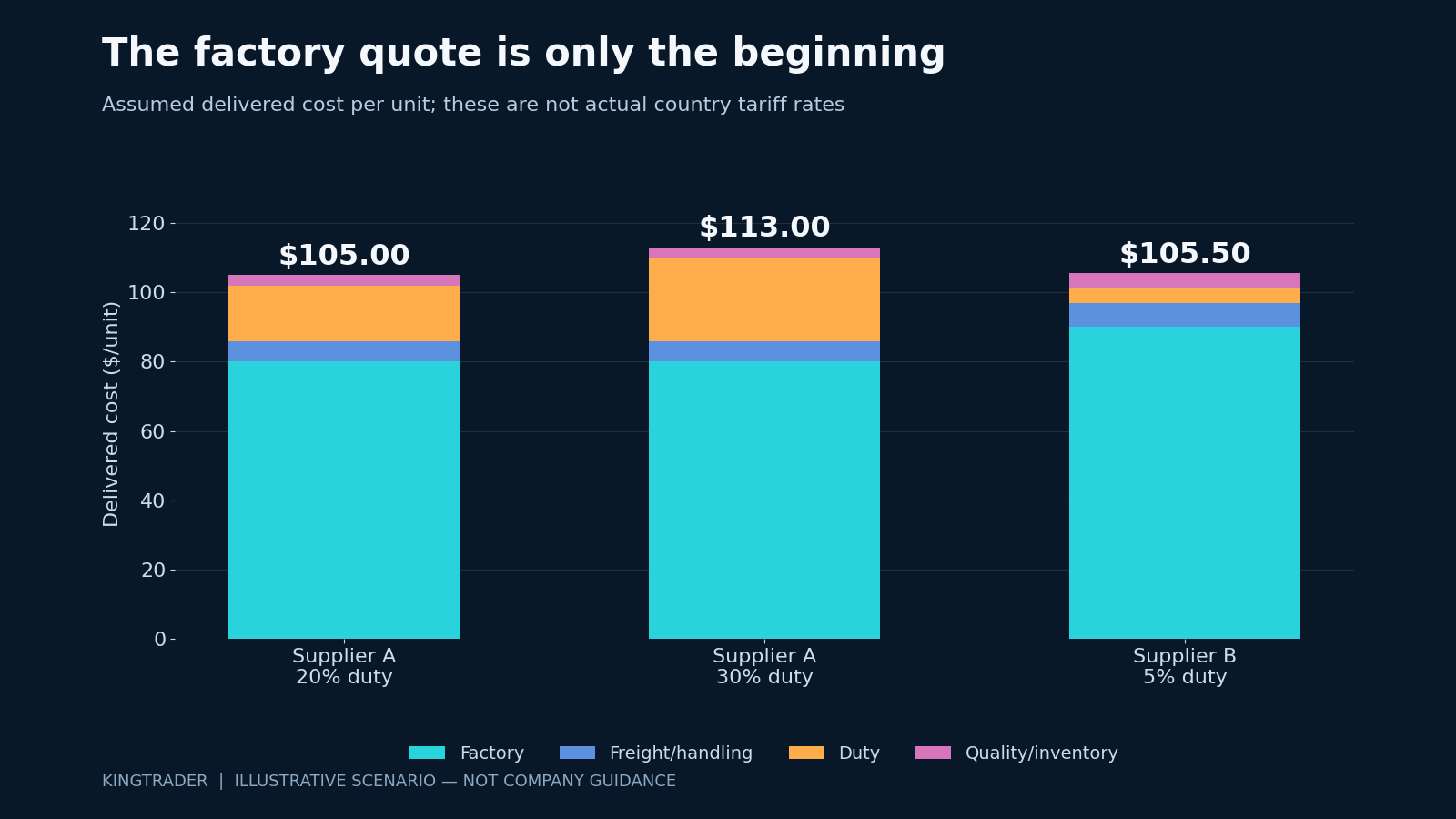
Consider a hypothetical product sold for $150 per unit. Supplier A charges $80 at the factory. Assume $6 for freight and handling, a duty of 20% applied to the assumed $80 customs value, and $3 for expected quality and inventory costs. Delivered cost is $105: $80 plus $6 plus $16 plus $3. Contribution before selling expenses and overhead is $45.
Supplier B charges $90, with $7 freight and handling, an assumed 5% duty on its $90 customs value, and $4 quality and inventory costs. Delivered cost is $105.50 and contribution is $44.50. Despite the $10 factory-price gap, the suppliers are almost tied. These duty rates are illustrative assumptions, not current rates for a real product or country; actual customs valuation can differ.
If A’s assumed duty rises to 30%, delivered cost reaches $113 and contribution falls to $37. B then offers a $7.50 contribution advantage per unit. But suppose qualifying B requires $250,000 of tooling and launch costs. At that unit advantage, roughly 33,334 units are needed to recover the initial cost, before financing and execution risk. A planned order of 10,000 units does not justify the same decision as a dependable multi-year programme.
The calculation should also test the opposite outcome. If A’s tariff falls, B’s apparent advantage may disappear. A diversified arrangement can still be worthwhile for reliability, but the buyer should price that reliability explicitly. A business that relocates solely to capture a temporary rate difference risks replacing one exposure with another.
Apple: diversification requires an ecosystem
Apple’s August 6, 2025 announcement of its American Manufacturing Program described partnerships across components, fabrication and packaging, including Corning, Texas Instruments, GlobalFoundries and Amkor. It also increased its stated US commitment to $600 billion over four years. That is a broad announced commitment, not proof of $600 billion already spent, and not a single factory-construction budget.
The useful lesson is the attention to interconnected capabilities. Glass, semiconductor manufacturing, packaging and engineering support cannot be evaluated as interchangeable suppliers of the same task. A supply-chain shift requires the surrounding processes to work together. Apple’s original announcement is an example of that coordinated approach, while its investment plans remain forward-looking.
A smaller manufacturer cannot reproduce Apple’s scale, but it can apply the same sequencing. Identify the critical component, qualify alternatives, verify the inspection process and test logistics before moving the entire order book. Contracts should define acceptable quality, remedies and responsibilities. The value comes from reliable production at scale, not merely from announcing a new sourcing country.
Working capital can decide the outcome
Suppose a business buys $5 million of goods annually and a new route adds 30 days to the cash tied up in inventory. Using a 365-day year, the incremental capital requirement is about $410,959. At an assumed 12% annual financing cost, that adds about $49,315 a year. This simplified calculation treats purchases as evenly distributed and excludes supplier credit; real seasonal businesses may need much more peak funding.
An operator may overlook this expense because it does not appear in the supplier’s quote. Yet the cash must come from somewhere. If the business is already constrained by a credit line, additional inventory can prevent it from accepting profitable orders. A cheaper unit can therefore reduce growth capacity by absorbing scarce working capital.
Shorter lead times have option value. They allow a buyer to order closer to observed demand, reducing markdowns and obsolete stock. For fashion, electronics accessories or promotional goods, that flexibility can exceed a small factory-price advantage. For standardised products with stable demand, the calculation may favour a larger, cheaper production run. Product economics should drive sourcing policy.
Country of origin is not a shipping address
Sending goods through a third country does not automatically change their origin or duty treatment. Origin rules are product- and jurisdiction-specific, and some preferences depend on additional requirements. A business should establish the applicable classification, origin and documentation with qualified customs support before relying on a cost benefit. Re-labelling or rerouting cannot be assumed to create lawful tariff savings.
Commercial terms matter too. An Incoterm allocates specified responsibilities and risks; it does not resolve every regulatory obligation or every cost dispute. Confirm who is importer of record, who pays duties and how tariff changes affect the agreed price. A seemingly attractive delivered quote can hide assumptions that become expensive when policy moves.
What the trading opportunity really is
Investors can look for businesses that help customers manage complexity: inspection services, specialised logistics, customs software, automation and component suppliers with qualified capacity. But exposure to a fashionable theme is insufficient. The question is whether extra demand produces higher margins and cash after the investment required to serve it.
A logistics company may handle more complicated routes while facing higher fuel costs. An industrial-park developer may attract interest while spending heavily on infrastructure before tenants commit. A supplier may win contracts at aggressive prices that fail to cover ramp-up costs. Compare orders with revenue, revenue with operating profit, and operating profit with cash flow.
Tariff headlines can also move currencies, shipping shares and exporters before the detailed policy is available. An announcement trade needs a clear distinction between expectation and implementation. The investor should identify what the market already assumes and which published document would confirm or overturn that assumption. Broad optimism about a truce is not a substitute for knowing the affected products.
A practical way to make the decision
Build three scenarios: current policy, a plausible tariff increase and a plausible reduction. Include freight volatility, quality costs, tooling and working capital. Weighting those scenarios requires judgement; avoid pretending their probabilities are precise. The purpose is to find whether a supplier remains competitive across a reasonable range of conditions.
Next run a limited qualification programme. Measure defect rates, on-time delivery and actual landed cost. Keep the original source available while the alternative proves itself. Dual sourcing can cost more per unit but protect continuity; its value should be compared with the expected losses from a disruption, including lost sales and restart costs.
Is China-plus-one always cheaper?
No. An alternative location may have higher component, freight or quality costs, and the origin rules may limit the expected tariff benefit. It can still be valuable as risk management. The decision should be made on total delivered economics and resilience, rather than a slogan.
What should investors monitor after a relocation announcement?
Watch capacity qualification, customer orders, utilisation, gross margin and working-capital consumption. Those figures reveal whether the strategy has become an operating advantage. A factory announcement is the start of the story. Consistent delivery and cash generation are the evidence that it works.
Sources and further reading
- Reuters, proposed US-China tariff cuts, September 28, 2026
- WTO, Goods Trade Barometer, September 9, 2026
- Apple, American Manufacturing Program, August 6, 2025
- WTO, World Trade Report 2026 executive summary
- Related KingTrader analysis: capital investment and cash flow
KingTrader editorial analysis. Illustrative scenarios are not company guidance, price targets or personalised investment advice.
Related Posts:
 Copper Trading 2026: Why a Supply Shortage Is Not a…
 Gold Trading 2026: Inflation, Real Yields and Miner Risk
 AI Spending Boom 2026: Who Turns the Hype Into Cash Flow?
 Oil Price Shock 2026: Who Can Protect Their Margins?
 Stablecoin Business Model 2026: Who Captures the Profit?
 Private Credit Risks 2026: Is the Yield Turning Into Cash?
Leave a Reply