Research cutoff: September 30, 2026. Company announcements and forecasts retain their original dates.

A private-credit fund can report income without receiving the same amount in cash. That fact is neither an accusation nor a technical curiosity. It is the starting point for understanding whether an attractive yield is supported by borrowers that can pay, and whether investors can obtain liquidity when they need it.
Private credit risks in 2026 centre on three connected questions: the borrower’s capacity to service debt, the lender’s ability to recognise deteriorating value, and the fund’s ability to meet its own obligations. A high contractual coupon answers none of these questions on its own. The business model works when underwriting, financing and investor time horizons fit the underlying loans. It becomes vulnerable when reported income is mistaken for available cash.
Why the issue matters now
The IMF’s April 2026 Global Financial Stability Report described rising borrower stress and greater retail exposure as possible tests for semiliquid private-credit structures, while noting that liquidity mismatches remained limited. This is a differentiated warning, not a declaration that all private credit is in crisis. Read the IMF report for the wider financial-stability context.
A separate September 28 Financial Times report described wealthy investors borrowing against private-equity holdings as distributions slowed. That report concerns private equity and NAV lending, not evidence of defaults across private-credit portfolios. Its relevance is the pressure created when expected cash distributions fail to arrive. Illiquid investments can remain valuable while their owners urgently need cash.
The core problem: the coupon is a promise
Private credit generally involves negotiated lending outside the broadly syndicated public debt market. Borrowers may value speed, certainty and tailored documentation. Lenders may obtain a premium for complexity, illiquidity or the risk involved. That premium has to compensate for genuine costs. It is not an extra return available without a corresponding exposure.
Start with the borrower’s cash generation. Revenue pays operating expenses, taxes, maintenance investment and working capital before supporting debt service. EBITDA can help compare operations, but it excludes several cash demands. A company reporting healthy EBITDA may still struggle to pay interest if customers pay late, inventory absorbs money or capital expenditure is unavoidable.
Loan protections then determine what happens when performance weakens. A covenant can trigger a discussion before a missed payment, but the benefit depends on its definition and enforcement. Generous adjustments to earnings can make leverage appear lower than it is. First-lien status establishes priority over specified collateral; it does not guarantee recovery of the full loan if that collateral loses value.
Payment-in-kind interest: useful flexibility or delayed trouble?
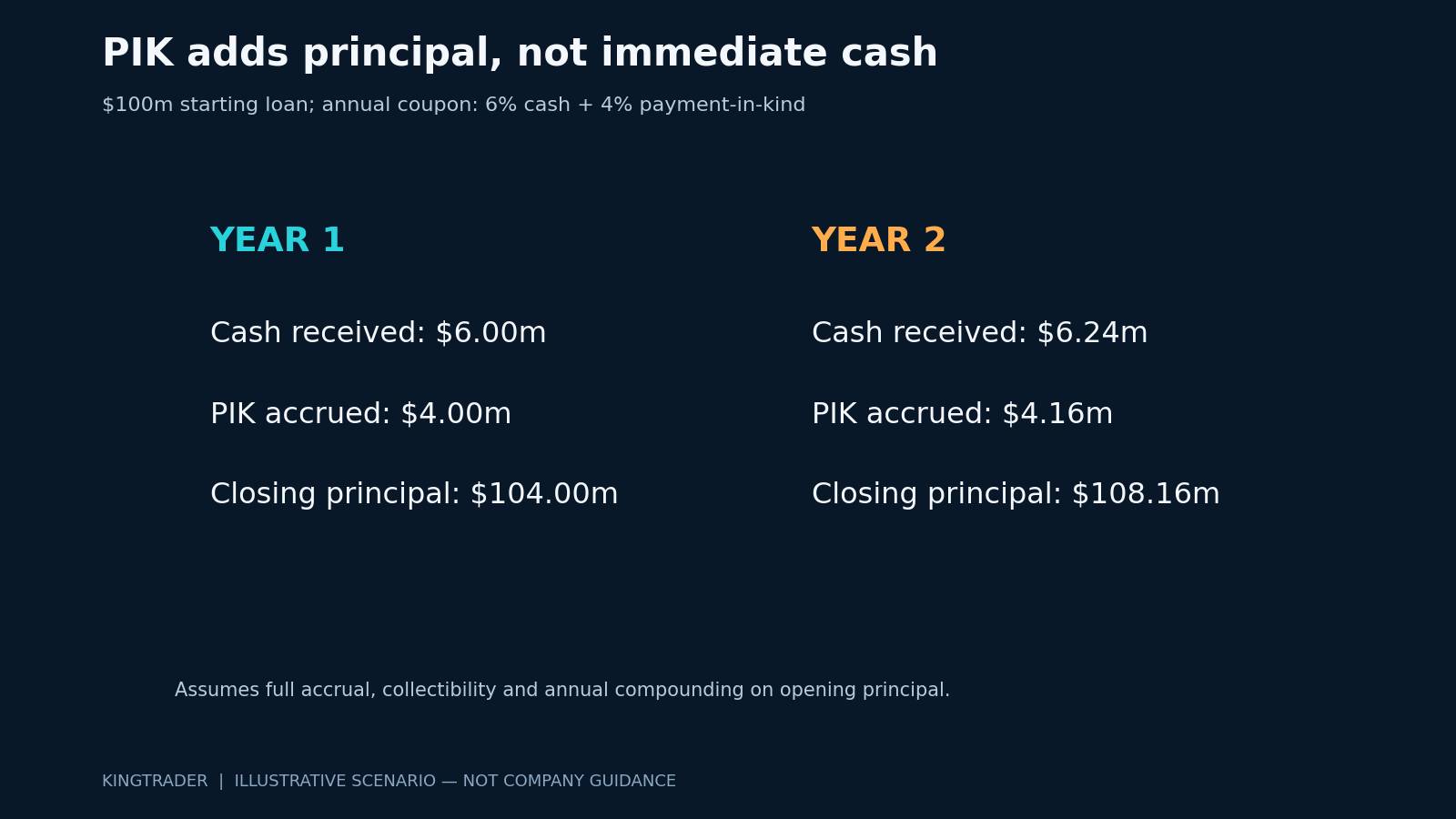
Payment-in-kind, usually abbreviated PIK, allows interest to be added to principal rather than paid immediately in cash. It can be part of the original financing design or a later amendment. The first situation may fund a planned growth period. The second may reveal that the borrower cannot support the original cash payment. Investors should distinguish the two before interpreting a rising PIK share.
Consider an explicitly hypothetical $100 million loan with a 10% annual coupon, comprising 6% cash interest and 4% PIK. In the first year, assuming full accrual and collectibility, the lender records $10 million of interest but receives $6 million in cash. The loan principal increases to $104 million. If the same split applies to the opening principal in year two, cash interest is $6.24 million and PIK is $4.16 million, raising principal to $108.16 million.
The added principal becomes a real return only if it is ultimately repaid or recovered. If the borrower is failing, continuing to add claims does not create new economic resources. The lender may need to stop accruing income or reduce the loan’s valuation. Accounting treatment depends on the instrument and applicable rules; the example is meant to explain the cash mechanics, not prescribe a recognition policy.
PIK also changes the borrower’s future refinancing problem. Short-term cash relief can leave a larger amount due at maturity. A successful growth investment may justify that bridge. A business with shrinking demand may simply arrive at the same problem later with more debt. The critical evidence is what the borrowed time enables the company to achieve.
Ares Capital: read both the metric and its denominator
Ares Capital’s July 29 release for the quarter ended June 30, 2026 reported non-accrual loans at 2.4% of investments at amortised cost and 1.4% at fair value. The corresponding December 31, 2025 figures were 1.8% and 1.2%. It also reported 71% floating-rate securities at fair value. These are company portfolio disclosures, not default rates for the entire industry. The SEC-filed release provides the definitions and full context.
The different non-accrual percentages are important. A troubled asset can be marked below its original cost, making its weight smaller under a fair-value denominator. The lower figure therefore does not independently prove stronger credit performance. Compare both measures over time, then examine recoveries, restructurings and migration in portfolio quality.
Ares Capital is a listed business development company. Its shares trade on an exchange, so an investor can generally sell shares in the market, subject to market conditions. That differs from withdrawing capital at net asset value from a semiliquid fund. A listed share price can fall below NAV, providing a liquidity outlet at a potentially unattractive price. The wrapper changes how liquidity risk reaches the investor; it does not remove the underlying loan risk.
The borrower’s interest-rate squeeze
Imagine a business with $100 million of debt and $20 million of annual EBITDA. At an assumed 10% interest rate, interest expense is $10 million and EBITDA interest coverage is 2.0 times. If the rate rises to 12%, interest is $12 million and coverage falls to about 1.67 times even without an operating decline.
Now let EBITDA fall 20% to $16 million. Coverage becomes about 1.33 times. If annual maintenance capital spending, cash taxes and working-capital needs together consume another $6 million, only $10 million remains before interest. The company faces a $2 million shortfall against the $12 million payment. This simplified scenario ignores many real-world details, but makes the key point: an acceptable-looking EBITDA ratio can coexist with insufficient cash.
Floating-rate loans can lift lender income as reference rates increase, yet simultaneously weaken the borrower. The benefit has a limit. Beyond that limit, higher contractual income may lead to more amendments, PIK, non-accruals and losses. Rate cuts can ease borrower pressure while reducing lender income. Neither direction is uniformly favourable.
Fund financing adds another layer
A lender may borrow to finance its loan portfolio. The spread between asset income and financing costs supports shareholder returns, while leverage magnifies both gains and losses. Asset and liability rates may reset at different times, and interest-rate floors can make the relationship nonlinear. A simple assumption that every rate change increases the spread is unreliable.
Liquidity is equally specific. Committed credit facilities can support funding, but access may depend on borrowing bases, asset eligibility and covenants. A headline liquidity number can include borrowing capacity rather than cash already available. Read the definition before comparing it with redemption requests or debt maturities. Unfunded borrower commitments also create potential future cash demands.
At a semiliquid fund, investor repurchase requests may exceed the amount allowed in a period. The fund’s documents determine limits, discretion and allocation. Those limits can protect remaining investors from forced sales, but they mean a requested withdrawal is not the same as guaranteed cash on a chosen date. Investors should understand that before treating the fund as a cash substitute.
A better due-diligence sequence
First reconcile income with cash. Identify how much interest is paid, how much is accrued or capitalised, and whether PIK is concentrated in weakening borrowers. Review dividend or distribution coverage using the appropriate earnings definition, but also ask how the cash payment is funded. A distribution can come from income, asset sales, borrowing or capital; the economic consequences differ.
Second study loan quality. Track non-accruals at cost and fair value, realised losses, valuation changes and covenant amendments. Check whether the fund relies heavily on one sponsor, sector or business model. A large number of borrowers does not guarantee diversification if they respond to the same economic shock.
Third study funding and access. Compare liabilities with asset maturities, inspect facility conditions and understand the investor’s exit route. For a listed BDC, test the purchase price against NAV and earnings scenarios. For a semiliquid fund, read the repurchase policy and consider the effect of receiving less cash than requested.
Is PIK always a warning sign?
No. It can be sensible in a financing designed around future cash generation. The warning is a growing reliance on PIK without credible progress toward repayment. An amendment that postpones cash payments should be assessed alongside operating performance and a realistic exit or refinancing plan.
Does a stable NAV mean low risk?
Not necessarily. Private assets are valued periodically, often with models and judgement. Low reported volatility can reflect the valuation process as well as underlying stability. Investors should examine valuation assumptions and observable transactions, rather than equating a smooth line with the absence of economic risk.
Private credit can provide useful financing and attractive returns. The disciplined investor follows the sequence from borrower cash generation to lender receipts to investor distributions. If that chain is sound, the yield has substance. If the chain breaks, the coupon remains a promise.
Sources and further reading
- IMF, Global Financial Stability Report, April 2026
- Ares Capital, June 30, 2026 results, SEC filing
- IMF, The Rise and Risks of Private Credit, April 2024
- Financial Times, borrowing against private equity, September 28, 2026
- Related KingTrader analysis: business investment and cash flow
KingTrader editorial analysis. Illustrative scenarios are not company guidance, price targets or personalised investment advice.




Leave a Reply